The federal FOIA does not provide access to records held by state or local government agencies, or by private businesses or individuals. This includes, but is not limited to, school transcripts, school district records of attendance or an individual's criminal record. ... Complete the FOIA
Thursday, 21 March 2019
As well as regulatory bodies, there are a number of legal legislations that must be considered and followed. The Freedom of Information Act (FOIA) generally provides that any person has the right to request access to federal agency records or information except to the extent the records are protected from disclosure by any of nine exemptions contained in the law or by one of three special law enforcement record exclusions.
The federal FOIA does not provide access to records held by state or local government agencies, or by private businesses or individuals. This includes, but is not limited to, school transcripts, school district records of attendance or an individual's criminal record. ... Complete the FOIA
The federal FOIA does not provide access to records held by state or local government agencies, or by private businesses or individuals. This includes, but is not limited to, school transcripts, school district records of attendance or an individual's criminal record. ... Complete the FOIA

21.3.19-Podcast Case Study
BBC podcast Case Study Questions
- What does the Role of a production designer entail? Responsible for the overall look of a production, the design atmosphere, in the hierarchy of importance within a production, the production designer comes after the director.
- During a production, which other members of the production and which other areas of the production does the production designer coordinate with? The production designer will have to converse with mainly the director about the feel/ look of the production, for building sets and locations. A production designer would also have to discuss the look of the costumes with the costume designer and the lighting with the DOP.
- What issues with locations can occur during the production of a TV drama? The location has to be realistic as possible, however a lot of them are tourist attractions so they're not always accessible.
- What skills, education and experience is it beneficial for a production designer to gain? Art schools , work experience on sets, Artistic background, volunteering and having a clear understanding of the role you would like to work in.
- During the production process itself, where are the working locations that a production designer tends to work and how do these relate to the actual filming of the TV drama? The production designer tends to work on the construction sides so working very closely to set and locations, this is where the organisation of props takes place. Graphic designer - makes really researched products. Seamstress- Sows so responsible for a lot of the props within the production. Production designer is never on set watching the filming, but responsible for mostly the planning of the overall production.
Thursday, 14 March 2019
27.11.18- Published notes
Roland Barthes and 'the rhetoric of the image'
In 1977 , Roland Barthes wrote 'The Rhetoric of the image' and through a considered analysis of advertising , argued that there are two levels to any sign or visual representation.
Barthes suggested that denotation tends to be described as the definitional, literal, obvious or common sense meaning of what is seen. Connotation, however, is when the audience brings the established or naturalised meaning to what they see.
Barthes conducted many semiotic analyses of advertising in order to demonstrate how products were sold and how ideologies become naturalised. This theory must be applied when analysing the technical codes of any media product. If we take the sound in TV or film, then the off-screen , denotive noise of an ambulance siren will connote danger or disruption for the character.
We can apply this idea to the basic Mise en scene elements such as colour. Red is often believed to connote danger and pink symbolises love.
Layout- This is how the elements on the page are presented. If you think about the juxtaposition of elements on a page, for magazines and newspapers it is the main image and the masthead.
House style and colour scheme- These are important elements because they give the product a brand identity. The fonts, colours and style of text layout will remain similar across all marketing material.
Photography techniques- This is important in particular for advertising and magazine design. Close ups and medium close ups for example, are used on magazine covers to denote the main cover star.
Captions- These are used to anchor the meaning of a product. Captions are used on newspapers and magazine photographs to tell the audience what the image is about and who it is of.
12.11.18- Published notes
Mise en scene
Mise en scene is the term we use to identify all of the elements in a shot or sequence that aren't covered by the other categories.
The term is French and roughly translates as 'put in scene'. As with a lot of film and TV analysis, it is an idea that has come from theatre- everything on stage is artificial and is carefully placed to add to the overall effect that the director wants to achieve. Exactly the same can be said about film and TV.
Setting- where it is shot
Set- the stage it takes place in
Lighting- use of light and shadow
Costume and Makeup- how the characters are physically created
Props- how objects add to the scene
Colour- use of colour on all of the above and filters applied to the film
Sound and Music
Soundtrack: Score- Music composed specifically for film/TV show
Incidental Music- Background music
Themes- Musical pieces used to represent a character, location or brand
Sting- A loud pulse of music for shock/comic event
Ambient Sound- environmental sound of a location eg traffic noise
Synchronous /asynchronous sound- Sound that either matches the timing of action on screen (synchronous) or is not in time (asynchronous)
Sound Motif- A short, repeated sound or melody that signifies a character, event or location
Sound Bridge- A piece of sound, dialogue or music used to bridge between scenes
Dialogue- The words spoken by actors in a scene
Voiceover- Dialogue dubbed over a scene, outside of the action
Monday, 4 March 2019
6.11.18- Published notes
Cuts- These are instant switches between shots, always use the word cut.
Transitions- Switches between shots that take time, like dissolves, fades or wipes.
The frequency and rhythm of cuts- How often cuts happen and whether they happen at the same time as actions or sounds.
Specific editing techniques- Shot reverse shot, crossing cutting, action matches.
These are all elements of continuity editing, where editing is supposed to make sense of time and place for the viewer.
Non continuity techniques include flash backs/forwards montages etc.
Shot reverse shot or shot counter shot- Cutting back and fourth between two established shots - very common for conversation.
Eyeline match- Ensuring that the eye level between character matches between cuts (so they look like they're looking at each other), or cutting from a character looking at something to the thing they are looking at.
Action match - Cutting to continue the action eg shot of a ball being thrown cutting to a shot of the same ball being caught.
Jump cut- A cut that suddenly shifts position or time unnaturally , in order to communicate that something is wrong.
Cross cutting/ parallel editing- Cross cutting between two sequences of action that are happening at the same time , often to link the characters to both actions.
Cutaway- Cutting to a brief shot in a sequence for a variety of technical or narrative reasons- it will be of a shot not covered in the master shot.
Insert- Similar to a cutaway but it will cut to a shot that is covered by the mastershot.
Transitions
Dissolve- One shot blending into another with no fade in between.
Fade in - fading into a shot from a colour, most likely black.
Fade out- Fading out from a shot to a colour , most commonly black.
Wipe- The new shot moves over the old shot in a direction, often motivated by an object or character.
1.11.18- Published notes
Long/ wide shot- Sets the scene, shows scale
Medium shot- Shows the characters interacting
Close up- Allows us to see emotion and detail
Two shot- Very common for conversation
Over the shoulder shot- To show connection
Low angle- Looking up sometimes makes the audience feel vulnerable
High angle- looking down sometimes makes the audience feel powerful
Point of view shot- looking directly through the eyes of a character
An establishing shot is usually the first shot of a new scene, designed to show the audience where the action is taking place. It is usually a very wide shot or extreme wide shot.
A master shot is a film recording of an entire dramatized scene, from start to finish, from an angle that keeps all the players in view. It is often a long shot and can sometimes perform a double function as an establishing shot.
Camera Movements
Pan - Camera stays in one position and rotates around a point right to left or left to right.
Tilt- Camera stays in one position and rotates around a point up or down.
Tracking- Camera moves smoothly along a track in a lateral (straight lines).
Dolly- Similar to a tracking shot, but the camera is on a wheeled mount that can move in all directions.
Crane- Camera is on a jib arm with a counterweight that be raised and lowered.
Steadicam- Camera is strapped to the operator with a stabilisation rig allowing for smooth movements across all surfaces.
Handheld- Camera is held in hand and will film bumpy footage.
The organisations or elements within the frame
Symmetry and asymmetry for emphasis
Depth of field - using focus to make the viewer concentrate on elements.
The rule of thirds- An imaginary 3x3 grid that can be used to make shots more dynamic.
29.10.18- Published notes
Codes : The familiar and predictable forms and techniques used by producers when creating media texts. These are used to communicate certain ideas or to convey a desired impression. Indicators or signs contained within a product that when identified by the audience create meaning.
There are two types of code: the technical and the symbolic. Technical codes are created through the way equipment is used to produce a media product. For example a camera can be used to present a particular characters point of view. Symbolic codes point the audience towards meaning that are not always apparent. For example in early Hollywood films the villains always wore black as this was seen in western culture as representative of evil.
Conventions: The commonly accepted ways of doing things. There are general conventions in all products, such as the use of opening credits in audio visual products. However, conventions can also be genre specific, such as the chase in action/ adventure films.
Genre: Media products are usually classified into categories and sub-categories. These categories are referred to as a products genre. By categorising a product, its audience will have a set of expectations that they will look forward to being met. For example, the audience for a horror film will expect to be scared. A product within a genre can be identified by its distinguishing features; its codes and conventions.
Verisimilitude: How real the world of the story or narrative of a fictional media product appears to the audience (for example, is the world presented to the audience believable?)
Thursday, 7 February 2019
7.2.19- Copy right and intellectual property
Questions
What arguments does Wired use to give its opinion on copy right laws?
The wired article suggests that most people do not know that cover songs need a synchronisation licence ' and even if they did, trying to get one is a confusing and expensive process'. The article is opposing to youtube rights and that it is somewhat extensive considering many people are not educated on the fact that you need a synchronisation licence to upload over songs.
Do you think UGC artists covering songs should be subjected to copyright laws?
I believe similarly to the article that having a licence to be able to upload cover songs is a long and complex process so therefore I think maybe some rights should still be in place however not as such a long and complicated process. I also believe that the people singing the cover songs could be used as a way to promote the current singers as its a way of advertising the artists songs.
Why is the video maker being sued?
The youtube entrepreneur , Michelle Phan, is being sued due to the record label 'ultra records' claiming that the music of Kascade is used too frequently in her videos. However Kascade said there was very little he could do to stop the case, thinking it was unnecessary and tweeted ' I wrote that all a month ago. Copyright law is a dinosaur, ill-suited for the landscape of todays media'.
Why do you think the opinions of the artists and label records differ?
Because the record label has many artists that they have to monitor and work with so therefore as a company they may worry that they lose money due to other people using their artists songs. However, the artists want their music to be popular and be heard therefore their opinion on copyright of their music is not as strong.
Sunday, 20 January 2019
18.10.18- Published notes
Technological Convergence
Technological convergence is the process in which different technologies are combined in one, increasing the amount of functions it can perform for the user.
Technological convergence is the process in which different technologies are combined in one, increasing the amount of functions it can perform for the user.


8.10.18- Published Notes
Web 2.0 Bullet Points
- Second stage development of the internet, characterised by the change from static web pages to dynamic or user generated content and the growth of social media.
- Invented by Darcy DiNucci in 1999 and popularised several years later by Tim O'Reilly.
- Social media marketing (a feature of web 2.0) Instagram, Facebook, YouTube - most visited websites.
- Networking is one of the most essential needs in todays world.
- Efficient networking is backed by internet. Therefore, two thirds of the total number of internet users visit social media websites daily. It has became an addiction to many.
- popular communication media: Snapchat. There are daily updates on snapchat filters that people would put on their story or send to their friends. A particular example of an advertising filter is for the Teenage Mutant Ninja Turtle film. I remember scrolling through the snapchat filters and seeing this filter with the caption of "In the cinemas today". This is a very clear and simple way of below the line advertising, and was used by many to advertise the new upcoming film. This proves how Web 2.0 has changed advertising as the youth generation use snapchat daily so to use a popular social media to advertise increases the success and popularity of the film.
- Another example includes the information search engine. Web 2.0 has this feature to help find relevant information for the keywords entered, this can advertise certain things for example just typing up the letter 'v' comes up with the option of the new upcoming film venom. This is therefore another subtle way of advertising as encourages the person using media to possibly click that option which then again is another way of advertising.
- Web 2.0 also introduced the idea of online gaming, advertising through this was used by Disney when the sequel series following the tangled film ' tangled ever after' came out on Disney channel, days before the Disney channel website released a game for the tangled ever after series, which is a method of above the line advertising. Web 2.0 contributed to the change of advertising for this new production as online gaming is a specific feature of Web 2.0 and clearly did advertise the aspects of the new series through a game relating the storyline which the target audience would play.
- Benefits Web 2.0 has for advertisers: make more profits from advertising as they do not have to pay as much money for advertising so highly beneficial. An additional benefit is that is more effective as by accepting cookies it allows advertisements to be seen making the internet more personal.
4.10.18- Published notes
Advertising
Above the line marketing: Above the line advertising is where a mass media is used to promote brands and reach out to the target consumers. These include conventional media as we know it, television and radio advertising, print as well as internet. This is communication that is targeted to a wider spread of audience , and is not specific to individual consumers. ATL advertising tries to reach out to the mass as consumer audience.
Below the line marketing: Below the line advertising is more one to one, and involves the distribution of pamphlets , handbills, stickers , promotions, brochures placed at point of sale, on the roads through banners and placards. It could also involves product demos and samplings at busy places like malls and market places or residential complexes.
Thursday, 17 January 2019
24.9.18- Published notes
Job Categories
Pre- production: The planning and drafting stages of a media product eg scheduling, funding, casting, designing, storyboarding, scriptwriting etc.
Production: The actual making of a media product eg filming, photographing, writing, inking graphics, recording sound etc.
Post-production: The editing and finalising of a media product eg adding special effects, digital manipulation, audio and video editing.
Wednesday, 16 January 2019
20.9.18- Published notes
Media Sectors
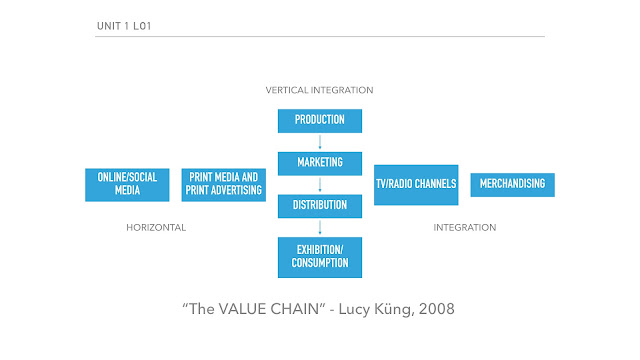
- Film
- Tv and Radio ( Broadcast Media)
- Video Games
- Print and publishing (including digital publishing )
- Web and online technologies (including social media)
- Music
Media conglomerates are structured in a way that maximises their reach whilst minimising their costs. The largest cost to a company is when they have to use services and providers outside of themselves to create or distribute their product. The most efficient conglomerate structure is to utilise vertical and horizontal integration.
When a media conglomerate uses different subsidiaries to promote and distribute a product. this is called synergy- An efficient way for a company to use all of its assets to the best effect. This is a primary reason for conglomerates to form.
Synergy is enabled by cross media ownership - when a conglomerate owns companies that specialise in different media, giving them an increased reach.
10.1.19- Niche vs Mainstream
The 'Bird Watching' magazine is an example of a magazine that is aimed at a niche audience.
 |
| This is because it is targeted at a specific audience and therefore a selective group of people that enjoy Bird Watching as a hobby. I believe this to be a niche audience as not everyone enjoys Bird Watching as a hobby so this magazine is extremely popular for the particular people that do Bird Watching often. Niche audiences are often more engaged , active and responsive users. Due to their specific likes, this makes it very easy for marketers to target content to them , instead of worrying about a large crowd with varying interest. As Bird Watching is for a niche audience, it would coincidently make it a lot easier for the creators of the magazine to receive feedback as it is a specific audience that would respond to the magazine.
The magazine Heat is an example of a magazine that is aimed at a mainstream audience
|
 |
| This is because its a more wider range of audience would chose to read this magazine. The age range of this magazine has a variety from 13 upwards. |


Tuesday, 15 January 2019
15.1.19 -21st century musical films
21st Century Musical Films

Musical film as a genre: Musical film is a genre in which songs sung by the characters and is sometimes accompanied by dance. The songs usually advance the plot or develop the films characters. Musical film is usually a natural development of the stage musical with the emerge of sound film technology. The viewer becomes the diegetic audience as the performer looks directly into the camera and performs to it.
Generic Conventions: For the main narrative of 21st century Musical films, songs are typically sung by characters to advance the plot and develop the films characters or themes. Singing in a movie isn’t what makes a musical , for it to be a musical characters must be expressing emotion through song and dance. They convey their thoughts and feelings (diegetic).
Mise en scene: Typically in musical films, emotions are expressed through lighting for example in the greatest showman in the first song “the greatest show” the lighting starts to become darker as it’s realisation to the audience that it is just A dream , this conveys the feelings in that moment. How at the time that the character is thinking or feeling. The costumes within musical films are usually well thought out and sometimes exaggerated for example the phantom of the opera the protagonist wears a. Mysterious mask along with a black cloak , costume is something that pleasures the audience. Musicals based on real stories (biographical )such as bohemian rhapsody the costume choices were really well thought out and exaggerated costumes was necessary. Sound is typically background music of the musical soundtrack which would then usually follow with a song where the characters would then sing and dance .
Camera: Close up shots are mainly utilised in musical films , for example to emphasise feelings again in high school musical 3, when Troy and his team aren’t winning it does a close up with a beating heart sound to increase the tension . Close ups are very helpful in musical films during songs so that is why they are commonly used. Shots to set the scene are also used quite frequently in musical films as most films start with a song. The shots within musical films follow a similar structure to any other genre of film however the shots are more emphasised when it comes to a song or dance.
Audience Pleasures: A finale song is a typical convention of musical films that please the audiences. This is because it is usually the song to clarify that everything is happy again and it is where the audience have anticipation from wanting a happy ending. Another convention audiences would expect from a musical film is a villain or villains , this is seen in mostly every recent musical film for enchanted it being the evil witch, high school musical - sharpay and finally hairspray it being Amber. These conventions keep the audience happy and encourage a successful production aimed at the target audience.In complete contrast , you wouldn’t typically see very realistic storylines as it isn’t realistic to break out to song and dance to express different emotions.
Sunday, 6 January 2019
6.1.19- Memento essay
Analyse the narrative structure of memento using the ideas
of prop, Todorov, Levi Strauss and any other theories you believe are relevant.
Give clear examples from the media.
Memento is a very long and complex story where the protagonist Leonard is seeking revenge for the murder of his wife while suffering from a short term memory loss condition. The media production is told through short pieces of the story in an inconsecutive series of events. Propp theories can be seen within the film production as Leonard is presented as the hero, John G is presented as the villain, Teddy can be seen as the helper/donor as to Leonard he is sourcing useful information therefore helping him to solve the murder. Finally, Leonards wife is presented as the princess and Natalie is the false hero of the narrative. The overall film doesn't strictly stick to Propp's ideas as at different times certain characters have different roles in the film. For example, at the beginning of the film, as someone who is watching, Teddy is presented as a villain as Leonard has written down not to trust him and we see that it says Teddy is John G. However through the short clips of story that we are shown, Teddy is only shown helping Leonard and he seems to be really interested in Leonards life so he is presented more as a helper/donor. Another way in which Memento opposes Propp's ideas is the character of Natalie. We see various moments of Natalie crying and trying to help Leonard which makes us as an audience sympathise with her and make her a likeable character, although as the film progresses we see more of the parts of memories for Leonard start to come together and it shows a completely contrasted character to Natalie where she is being abusive to him and saying she will use Leonard knowing that he will not remember any of those events. This immediately makes the audience dislike her, and her role within the film has aspects to being a villain as well as a false hero. Overall Propp's ideas are slightly in place in this film but it definitely opposes some of his ideas as most of the characters purposes either change or they have more than one.
Despite Propp having his ideas quite limited in Memento, I believe Todorov's theories are highly presented in the film. For example with the first stage of his theory being : 1. A state of equilibrium at the outset- so at the beginning of memento not everything is happy but it is calm, not much action has happened and there's lack of information for the audience to see, as all we see is a polaroid photo being shaken so a small amount of equilibrium is achieved . The second stage, 2: A disruption of the equilibrium by some action - there are many parts when the equilibrium would have been disrupted but a significant example would be when Leonard wakes up with a man in his wardrobe not knowing what had happened the day before which obviously made the equilibrium unstable as there was a tense atmosphere in this moment. The next additional stage in Todorov's theories is that there is an attempt to repair the distribution- So when Leonard called Teddy and then turned up to Natalie's house to find out who the man was this was an attempt at making the situation achieve equilibrium again. Finally, the last stage being that there is a reinstatement of equilibrium. The last few scenes don't necessarily answer a lot of questions and the there isn't really a proper ending as it is just implying that Leonard is going to keep trying to solve what happened as he stops at a tattoo shop to get a new tattoo. But this ending does still follow Todorov's theories as it ends with equilibrium.
Some aspects of Levi Strauss binary opposition can be seen in the film for example: good vs evil, Leonard is just trying to get revenge for the rape and murder of his wife whereas evil keeps getting in his way in small ways such as Natalie taking advantage of his condition then in big ways such as him not writing down important things that he needs to remember. Another use of binary opposition is Strong vs weak. Mostly everyone is stronger than Leonard due to his condition he is mentally weak so a lot of the other characters like Natalie and Teddy are automatically stronger than him. A final example is peace vs war, Teddy tells Leonard at the end that there is nothing more that he can do to make it any better whereas Leonard is still wanting war and revenge for the rape and murder of his wife. There isn't a lot of binary opposites in the film but some aspects of Levi Strauss Binary Opposition theory can be presented.
In conclusion, Todorov's Narrative is the most accurate and mostly presented in the film memento as the narrative is constantly falling in and out of equilibrium. The characters have some of the aspects of Propp's ideas as there is a clear hero of the story but the villain defiantly does alter and there could possibly be more than one villain in this case such as John G, Teddy, Natalie. Binary opposition is also quite a common theme and can be seen throughout as I said previously about good vs evil. Overall all if the media narratives above are commonly utilised in films in the past and future and they're important in storylines. As Memento is known for being a confusing and long film, the narrative structures help contribute to more understanding of the film.
Thursday, 8 November 2018
8.11.18- Editing techniques in chosen clip
Editing techniques in Kong skull Island
At the very beginning of the clip (0.23 seconds in) it shows a close up of a man looking through his telescope at whats going on around him. The use of this cut heightens the tension as from the reaction of his face, it is constantly building the tension as it goes quite slowly as he is taking the telescope down and goes immediately to the next shot using a jump cut. There is a variety of cuts within this clip to keep the viewers engaged with the heightened drama of the unexpected creature in the characters environment. The close up on the mans face as well also is useful for showing the detail of his shocked and scared face, again reinforcing the tension that building within this particular scene.
Next at 0.35, there is a slow camera movement blurring everything else except the monkey, the use of the slow pace in this editing technique focuses particularly on it helps maintain the tension. This uses a medium long shot to get all of the creature in the camera shot and at such a slow pace from cutting to it , this is another reinforced tension effect and still shows the intense atmosphere will keep occurring throughout the scene and that its still not over.
A final editing technique is at 2.33 when it uses a shot reverse shot, as it goes from the monkeys feet to the people constantly. This is cleverly used and not only used in this part but again it does help to bullies the suspense with the conflict between the creature and the characters.
Tuesday, 30 October 2018
30.10.18- Disney Conventions
Disney Animated Film
A commonly seen feature of Disney animated films would be the "True Loves First Kiss". This is seen whether its an escape from death or transformation into a human. Disney does this is target younger females They stick to this sort of storylines they can carry on creating similar films and therefore making more money. This particular idea is seen in snow-white when she dies form the poisoned apple she is woken up from a true loves kiss, similarly with sleeping beauty, aurora is in a permanent sleep and gets woken up from true love and finally with the little mermaid Ariel kisses Eric to become a permanent human so she can live with her true love not in a mermaid form.
The next idea that Disney have commonly utilised is "being friends with nature". This certainly helps Disney keep their younger viewers as young children love animals and the idea of being friendly with them. For example in snow-white: The character herself becomes friends with all sorts of animals and creatures including Rabbits and Birds. Also in Beauty and the Beast, Belle is seen to being very close with her horse again reinforcing the idea of being close with animals and befriending nature. Animal companions make younger children believe that all animals are nice and sugarcoat the danger.
Some of the older films such as Mary Poppins include singing, this is another popular method that Disney use. This is a clever method as majority of Disney viewers and target audience are part of the younger generations. This method is still popular today and can be seen in some of the newer and most recent films such as frozen and Coco.
Similarly, Disney have been sticking to having deeper morals into their storylines, for example newer films like UP: After losing his wife, Carl showed not to take life for granted and go out and do the things you always said you wanted to do. This encourages younger generations to look into being more morally correct. Alternatively in the Pixar film Finding Nemo , Disney wanted viewers to see that you have to let go of the ones you love eventually and again gives Disney viewers a thought provoking production.
Finally, Disney love to include the idea of "coming of age" this is seen in inside out when the parents within this film are oblivious to how she is growing up and moving on, in comparison to Toy story 3 when Andy is all grown up and not taking his toys to university with them, This communicates with the viewers and creates a relatable production for families watching.
In conclusion, Disney has many codes and conventions within all the old and upcoming films to keep their audiences interested therefore making them more money.


Subscribe to:
Posts (Atom)